ANPR Blender
A native EEVEE node for artist-controlled cel shading.
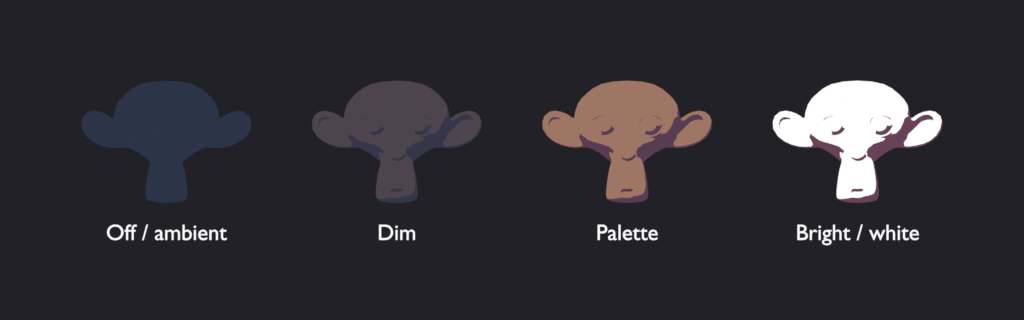
Actual ANPR development render: the same model and palette under four light strengths. The lit region moves toward white while the authored shadow color stays protected.
The workflow
- Start with authored light and shadow colors.
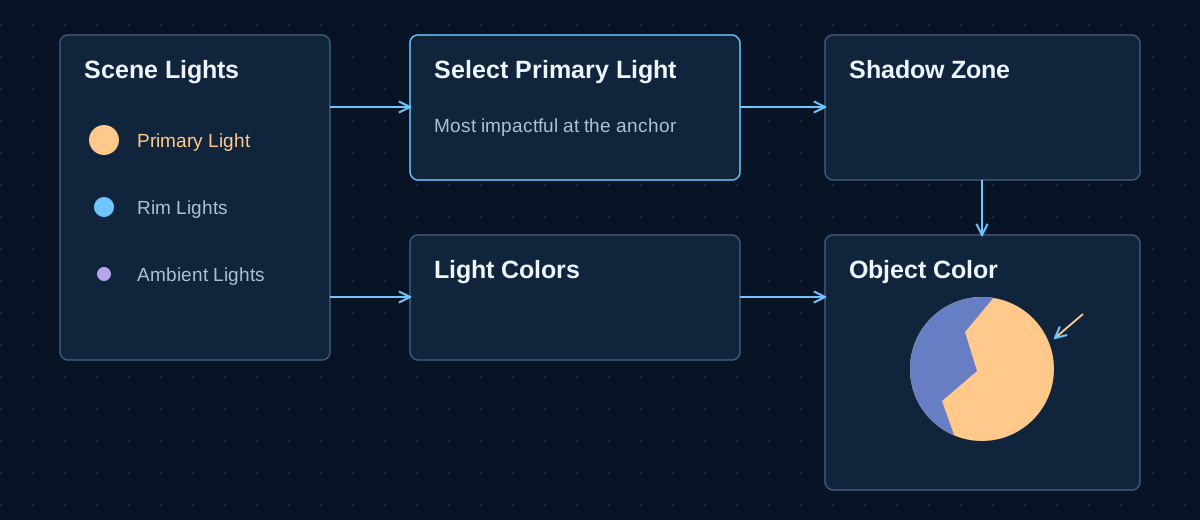
- Use the most influential scene light to place the light–shadow boundary.
- Let other lights influence the colors without adding extra shadow boundaries.
ANPR is a macOS Blender development fork. A public download, source release, and interactive demo are not available yet.
- The problem
- Keep authored flat light and shadow zones while responding to the strength and color of scene lights.
- The approach
- Use the dominant scene light to define the shadow boundary, and let the remaining lights influence the authored colors without creating extra shadow zones.
- The result
- A native EEVEE 2D Shading node in a macOS Blender development fork.
Development notes ·
The goal of ANPR is to make flat cel shading react to light similarly to the Principled BSDF shader. Most workflows based on Shader to RGB don’t respond to light color. While the new nodes in Blender 5.3 expose much more lighting information, there still isn’t an easy way to identify the primary light influencing an object and use it to define the light and shadow zones.
With ANPR, 3D artists can light a scene as they normally would. Their characters retain flat shading while reacting to changes in light strength and color, making the result less likely to immediately read as 3D.
Working with scene lights#
The starting idea was to identify the primary light influencing an object and use it to define the light and shadow zones. From there, I used the other lights as ambient contributions, influencing the colors based on their strength without creating additional shadow boundaries. This lets multiple lights affect the character while keeping the shading flat and readable.
I based the light response on the Principled BSDF shader so the workflow would feel familiar to 3D artists. Objects should respond to changes in lighting in the way artists generally expect from Blender, while retaining flat cel shading.
Controlling shadow shapes#
In 2D art, some areas of a character may always stay in shadow, regardless of the lighting. Other methods of replicating 2D styles in 3D often use this approach too, so I wanted artists to have a way to define those areas in ANPR.
ANPR is currently a macOS development fork based on Blender 5.3, with a native 2D Shading node in EEVEE. It is not publicly released yet.